
Houses of Health in Astrology: What They Really Mean for Wellness
Health rarely begins where symptoms appear. The body whispers long before it shouts, and in astrology those whispers are mapped across the architecture of the birth chart. Medical astrology approaches wellness not merely as a biological process but as a pattern woven between lifestyle, emotional states, and the subtle rhythms of planetary cycles. At the center of this approach lies an often overlooked tool: the astrological houses. These twelve sectors of the chart form the terrain of human experience, revealing where stress accumulates, where vitality thrives, and where hidden imbalances may quietly develop. To understand health astrologically is to read the body as a story—one written through the houses.
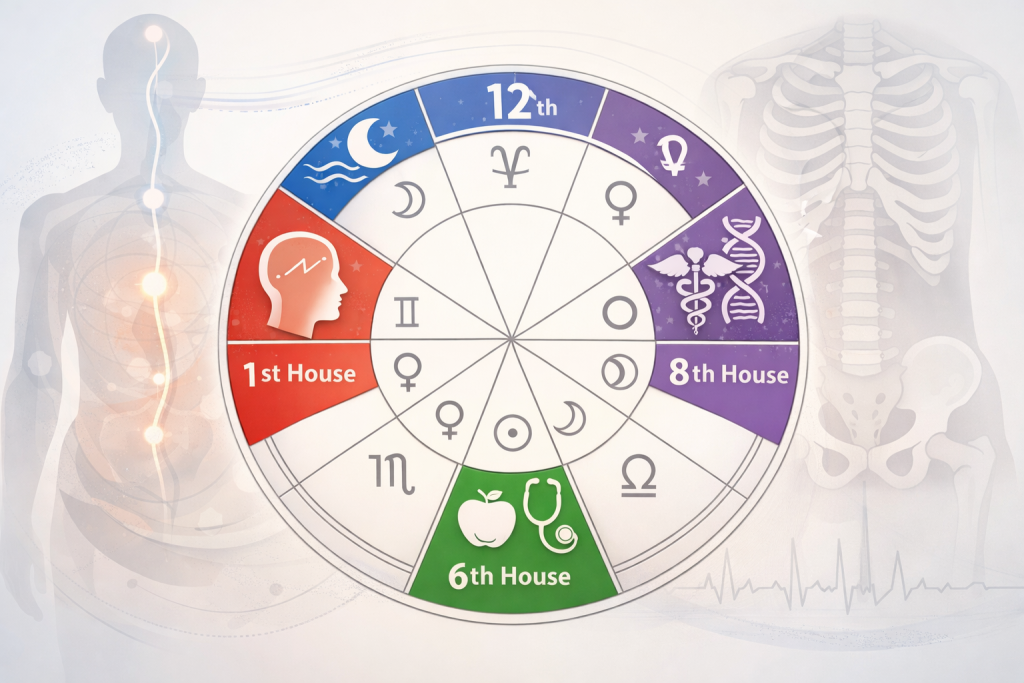
In traditional astrology, each house represents a distinct area of life: identity, work, relationships, inner psychology, and more. When viewed through a medical lens, certain houses become especially significant because they describe how physical and psychological wellbeing unfolds over time. While the entire chart contributes to a person’s health picture, four houses stand out as the structural pillars of medical astrology: the 1st, 6th, 8th, and 12th houses.
Understanding these houses is not about predicting illness or diagnosing disease. Instead, they reveal patterns—how lifestyle habits affect vitality, how emotional pressures manifest physically, and where deeper transformation may occur. Health in astrology becomes less about fate and more about awareness.
The Body’s Blueprint: The First House
The first house is the doorway to the entire birth chart. Often called the ascendant or rising house, it represents the physical body, constitution, and the way a person moves through the world. In medical astrology, this house is the baseline of vitality.
Everything begins here.
The sign on the cusp of the first house describes the body’s natural temperament—how energy flows through it, how quickly it recovers, and what kinds of physical sensitivities may exist. Planets placed in this house further refine the picture. A chart with strong Mars influence in the first house, for example, may indicate an energetic constitution but also a tendency toward inflammation or stress-related tension. Meanwhile, a more watery or sensitive ascendant may suggest a body that responds deeply to environmental and emotional stimuli.
Astrologically speaking, the first house sets the “tone” for health. It describes how someone reacts to stress, how resilient they may be, and how easily the body returns to balance. It is less about specific illnesses and more about the overall vitality of the system.
In this sense, the first house functions like the root of a tree. When the root is strong, the rest of the organism has a better chance of thriving.
The Sixth House: Where Lifestyle Meets Health
If the first house represents the body’s foundation, the sixth house governs the daily practices that sustain or undermine it.
Often described as the house of work, service, and routine, the sixth house is one of the most important indicators of health habits. It reflects diet, exercise, sleep patterns, stress management, and the rhythms of everyday life.
Many health challenges do not appear suddenly; they grow slowly through repeated habits. The sixth house reveals those patterns.
Planets in this house often point to areas where imbalance may emerge through lifestyle. For example, a strong Saturn influence could indicate chronic stress related to responsibilities or work pressure, while a Neptune placement may suggest sensitivity to medications, toxins, or emotional overwhelm.
In astrology more broadly, the sixth house is associated with service and productivity, showing how everyday routines shape physical wellbeing. (Glasp)
This connection highlights a profound truth: the body does not operate separately from daily life. How we work, eat, rest, and manage stress gradually shapes the state of our health.
When astrologers examine this house, they often look for clues about how a person handles illness. Do they ignore symptoms until problems escalate? Do they respond proactively? Do they thrive with structure or resist routine?
In many ways, the sixth house is where personal discipline meets physical wellbeing.
The Eighth House: Transformation and Deep Healing
The eighth house has a reputation for intensity. Traditionally associated with transformation, psychological depth, and shared resources, it also carries significant meaning in medical astrology.
While the sixth house often relates to everyday health habits, the eighth house speaks to deeper processes within the body—chronic conditions, inherited vulnerabilities, and the transformative nature of illness.
It is also connected to surgery, detoxification, and the body’s capacity to release what no longer serves it.
This house operates beneath the surface. Health matters linked to the eighth house often develop gradually, sometimes tied to emotional stress, trauma, or family patterns passed down through generations.
Yet the eighth house is not simply about difficulty. It is also the house of regeneration.
Just as the body can accumulate imbalance over time, it also possesses the remarkable ability to heal and renew itself. The eighth house symbolizes that profound cycle of breakdown and transformation—the way challenges can ultimately lead to deeper strength and self-awareness.
In medical astrology, this house reminds us that healing is rarely linear. Sometimes the most significant transformations occur in the hidden layers of the psyche and body.
The Twelfth House: Hidden Influences on Health
If the eighth house represents deep transformation, the twelfth house represents what lies beyond conscious awareness.
Often called the house of the subconscious, the twelfth house reveals patterns that remain hidden from ordinary perception. In terms of health, this house is associated with psychosomatic conditions, emotional suppression, and illnesses that arise from long-term stress or unresolved inner tension.
Historically, the twelfth house has also been linked to hospitals, isolation, and retreat. But this symbolism carries a deeper meaning: healing sometimes requires withdrawal from the noise of everyday life.
Individuals with strong twelfth-house placements often possess heightened emotional sensitivity. They may absorb stress from their surroundings or feel deeply affected by collective energies. Over time, this emotional load can manifest physically if not processed consciously.
However, the twelfth house is also connected to spiritual practices such as meditation, introspection, and solitude. These practices often become essential tools for restoring balance.
Rather than representing weakness, the twelfth house reveals the subtle interplay between mind, body, and spirit. It reminds us that health is not only physical but also psychological and energetic.
Other Houses That Influence Health
Although the four houses above form the core of medical astrology, other houses can provide additional context when analyzing wellbeing.
The second house, for instance, relates to nourishment and the physical act of eating. It can reveal patterns around food, self-worth, and how individuals sustain themselves materially and physically.
The fourth house often reflects emotional security and family influences. In many charts, it can reveal inherited health patterns or digestive sensitivities linked to emotional states. Astrological insights suggest the fourth house also represents the emotional body and internal sense of happiness. (Glasp)
The tenth house, traditionally associated with career and public life, may indicate stress related to ambition, responsibility, or social expectations. Long-term career pressure can significantly influence physical wellbeing.
Finally, the eleventh house highlights community and social networks. Support systems—friends, groups, and collective environments—play an important role in health, particularly in terms of emotional resilience.
Astrology rarely isolates one factor. Instead, it reads the chart as a web of interconnected influences.
How Astrologers Read Health in a Chart
Interpreting health astrologically requires far more than identifying one house or planet. The entire chart must be considered as a dynamic system.
Astrologers examine planetary placements, aspects between planets, and the rulers of each house to understand how different areas of life interact. For instance, the planet ruling the sixth house may appear in another part of the chart, linking health habits with relationships, career, or emotional patterns.
This interconnected approach reflects a key principle of astrology: every part of life influences every other part.
Modern discussions of astrology often emphasize personality, relationships, or career. Yet historically, astrology served as a holistic tool for understanding the rhythms of human life—including health.
Ancient astrologers believed that planetary movements reflected cycles within the body itself. Although modern medicine operates through different frameworks, the symbolic language of astrology continues to provide insights into behavioral patterns and emotional stressors that influence wellbeing.
Health as Awareness, Not Prediction
Perhaps the most important point in medical astrology is this: the chart does not determine destiny.
Instead, it reveals tendencies.
A challenging placement in the sixth house does not guarantee illness, just as a strong first house does not guarantee perfect health. What astrology offers is awareness—a way of recognizing patterns before they become problems.
When individuals understand their natural sensitivities, they can make lifestyle choices that support balance rather than undermine it.
Someone with a chart indicating high stress sensitivity may benefit from mindfulness practices, creative expression, or structured routines that protect their energy. Another person with strong fiery placements may need physical activity to release tension and maintain vitality.
Astrology, in this sense, functions less like a diagnosis and more like a map.
It shows where attention may be needed, where strength already exists, and where deeper healing may emerge.
The Body as a Cosmic Conversation
Medical astrology ultimately invites a different way of thinking about health.
Rather than seeing the body as a machine that occasionally breaks down, astrology suggests the body is part of a larger rhythm—one influenced by cycles, environment, psychology, and behavior.
The houses of health reveal how different dimensions of life interact with physical wellbeing. The first house speaks of vitality, the sixth of daily habits, the eighth of transformation, and the twelfth of hidden emotional currents.
Together, they tell a story.
And when that story is understood, health becomes less mysterious. It becomes a dialogue between the body, the mind, and the patterns written in the sky.